If you’ve ever stood in front of a pizzeria’s production line wondering why some operations look like a chaos of hands tossing dough, while others move with the quiet precision of a well-oiled machine, you’re not alone. As a pizza production line supplier, I talk to shop owners, head chefs, and operations managers every week who struggle to pick between manual and automated setups—half of them convinced automation kills the “artisanal” vibe, the other half terrified manual lines can’t keep up with weekend rush. Let’s break this down like we’re chatting over a slice (extra pepperoni, obviously) so you don’t have to sift through jargon or confusing specs. Pizza Production Line
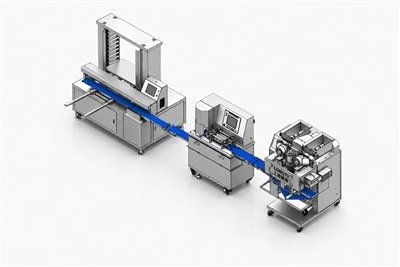
First, let’s get the basics straight: a manual pizza line is just a sequence of human-driven tasks, right? Like, one person stretching dough, another adding sauce, a third loading toppings, and a fourth sticking it in the oven. An automated one replaces most of those steps with machines—dough sheeters that roll out uniform crusts, robotic topplers that portion cheese, conveyor ovens that time bake cycles to the second. But the difference isn’t just “machines vs. people”; it’s how each handles consistency, speed, labor costs, and quality control, and where your business is right now.
Let’s start with consistency, because that’s the make-or-break for repeat customers. If you run a small local spot, maybe you’ve got a go-to dough stretch that’s just the right thickness, sauce spread that’s not too much or too little, cheese that melts perfect every time. With a manual line, that relies on every single person on shift being on their A-game. I’ve seen it a hundred times: a new line cook screws up the dough size, a sous chef is rushed and dumps way too much sauce, and suddenly a customer who ordered a medium margherita gets a thick, greasy mess that they’ll never come back for. Studies on food service consistency back this up: manual operations have a 10-15% variation in crust thickness, sauce portion, and topping amount per pizza, while automated lines keep that variation under 2%. It’s not just about looks—too much sauce makes the crust soggy, too little makes it dry, and customers notice even if they can’t name why. Automated lines also adjust for variables automatically: if the dough is slightly warmer one morning, the machine will roll it just a tiny bit thinner to keep the total weight the same, no human has to remember to check that.
Next up, speed—especially if you’re doing bulk orders, like a school cafeteria, a mall food court, or a chain with 10 locations. Manual lines top out at around 60-80 pizzas an hour per station, total. That means if you have a busy Saturday night where 150 people walk in at once, you’re scrambling, waiting 45 minutes for pies, and losing half your orders. Automated lines? They can pump out 150-300 pizzas an hour, no sweat. But wait—here’s the catch: automation doesn’t just work for high volume; it works for steady volume. If you only sell 20 pizzas a day, a manual line is way better, because automating even a small setup costs more than you’d make in a month. I had a client last year who ran a 30-seat spot, thought automation would “level up” their business, and ended up wasting $12k on a line that was way too much for their demand. But if they were a mall kiosk doing 200 pizzas a day? That same setup would pay for itself in 6 months.
Then there’s labor, which is probably the biggest pain point for most pizza business owners right now. Let’s be real: hiring and keeping line cooks is brutal. Turnover for kitchen staff is around 75% a year in the US, per the National Restaurant Association. That means you’re constantly training new people, dealing with calls out sick, and picking up shifts yourself. A manual line needs at least 3-4 full-time people to run smoothly, plus overtime during rushes. An automated line? You only need 1-2 people to supervise it—someone to load dough, check toppings, and troubleshoot if a machine jams. That cuts your labor costs by 50% or more, depending on your size. But wait—don’t sleep on the “soft labor” stuff. Some customers and even local suppliers love the idea of a place that “makes pizzas by hand” — a lot of artisanal pizzerias advertise their hand-stretched crust as a selling point, and they don’t want to lose that. I get it; that’s why I don’t push automation on every client. If your brand is built on “handmade” and you don’t need to handle super high volume, manual is totally fine.
Wait, let’s talk about flexibility, because that’s another area where people get confused. Manual lines are super flexible, right? You can toss a gluten-free crust, add a random topping someone requests, change the crust size on the fly, no problem. Automated lines are… well, you can change settings, but you have to adjust the machines, which takes time. For example, if your machine does 12-inch pizzas and someone orders a 10-inch, you have to swap the dough tray, adjust the toppling head, that kind of thing. That can take a few minutes, which is a problem if you’re swamped with custom orders. But here’s the new twist on automation: modern setups are way more flexible than they used to be. A lot of the lines I sell now can switch between 8-inch, 12-inch, and 16-inch pizzas in under a minute, no tools required. They also handle custom toppings pretty well—you just program the machine to skip certain toppings, or add extra, and it does it without a hiccup. So if you’re a mid-sized spot that does both regular and custom orders, you don’t have to choose. But if you’re a tiny shop that only does 12-inch pies, manual is still easier.
Quality control is another big one. With a manual line, you’re relying on each staff member to check their own work. You might have a manager walking around, but they can’t see every pizza that goes out. With an automated line, you can add small checks—like a scale that makes sure each pizza has exactly the right amount of cheese, a camera that spots a missing topping, even a reject bin that kicks out any pizza that doesn’t meet specs. That means less food waste, too. How? I’ve seen manual lines waste 10-15% of dough, sauce, and cheese because someone messed up a portion, dropped a pie, or made a mistake. Automated lines cut that waste down to 2-3%. Over a year, that adds up to thousands of dollars saved. Waste isn’t just money—if you’re trying to be sustainable, less food waste is a huge win, especially for customers who care about that.
But let’s be honest, there are myths out there. A lot of people think automated lines kill flavor. Is that true? Back in the day, yeah—early automated lines made crusts that were too uniform, toppings that didn’t stick right, the whole thing tasted “factory made.” But modern lines? They use the same ingredients, same baking times, same temperatures as a good manual line. The only difference is the consistency. A margherita pizza from a good automated line will taste just as good as one from a manual one, you just won’t get a random pizza with way too much sauce one day, or a crust that’s too thick the next. I’ve had blind taste tests with clients—most of the time, they can’t tell the difference between a well-made automated pizza and a manual one. The artisanal vibe is separate; you can still use fresh, high-quality ingredients with an automated line, you just don’t have to worry about a line cook overloading it with olives.
Another myth: automation is only for big chains. Nope. I’ve sold automated lines to 20-seat pizzerias that do 100 pizzas a day, to food trucks that do 50 a day, even to ghost kitchens that operate out of a tiny space. The key is picking the right size. You don’t need a 10-station industrial line if you’re a small spot—there are compact, semi-automated setups that mix manual and automated steps, so you get consistency without losing the hand-touched feel. For example, a semi-automated line might have a machine that stretches dough to uniform size, then you add sauce by hand, then the machine adds cheese and toppings, then a conveyor oven. That way, you get the best of both worlds: less work than a full manual line, keeps the hand sauce and toppings that customers love, and way more consistency.
Let’s wrap this up with a quick breakdown so you can decide what’s right for you. If you’re:
- A tiny shop (under 50 pizzas a day) building a local, handcrafted brand: Go manual. It’s cheaper, fits your vibe, and you don’t need the extra speed or consistency.
- A mid-sized spot (50-200 pizzas a day) or a chain/ghost kitchen dealing with regular rushes: Look at semi-automated or compact automated lines. You’ll save on labor, cut waste, and keep up with demand without ditching your brand.
- A high-volume spot (200+ pizzas a day) handling bulk orders or peak rushes: Full automated line is worth it. The speed, consistency, and labor savings will pay for themselves in months.
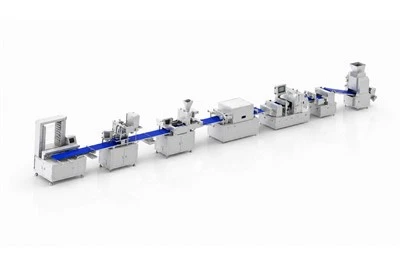
At the end of the day, it’s not about “manual vs. automated” being better—it’s about what fits your business, your brand, and your budget. I’ve seen places blow cash on a big automated line they didn’t need, and places struggle to keep up because they stuck to a manual line when they should have upgraded. If you’re tired of inconsistent pizzas, high turnover, or losing orders during rushes, we can chat through your specific setup, what your demand looks like, and what you want your brand to feel like. No sales pitch, no jargon, just straight talk about what will actually work for you.
If you’re ready to figure out which setup makes sense for your pizza operation, reach out to us to connect on your production line needs.
Meat Processing Lines References
National Restaurant Association. 2024. Restaurant Industry Workforce Trends and Turnover Rates. Food Service Technology Association. 2023. Automated vs. Manual Food Production Consistency and Efficiency Benchmarks. Pizza Marketing Quarterly. 2022. Artisanal Branding and Customer Perceptions of Automated Pizza Production.
Shanghai Longyu Electro-Mechanic Technology Co., Ltd.
Shanghai Longyu Electro-Mechanic Technology Co., Ltd. is one of the most professional pizza production line manufacturers and suppliers in China, featured by quality products and good service. Please feel free to wholesale advanced pizza production line made in China here from our factory. Also, custom service is available.
Address: No.66, Guangfulin East Road, Zhongshan Subdistrict, Songjiang District, Shanghai, China
E-mail: sales4@longyu-sh.com
WebSite: https://www.longyu-sh.com/
