Hey there, it’s Jake from your go-to hand-cranked clothes drying rack supplier—today I’m diving into a question I get asked nonstop, especially these days when everyone’s trying to cut costs without ditching quality: which is cheaper long-term, a hand-cranked drying rack or an electric dryer? I’ve had so many customers (from busy apartment dwellers to small boutique hotel managers) hit me up confused, because they think electric dryers are the “default” and hand-cranked racks are just a cheap DIY hack. Spoiler alert: it’s not that simple—there’s a lot more to cost than just the initial sticker price, and I’ve got hard numbers, real-user stories, and even some utility bill breakdowns to back this up. No fancy jargon, just straight talk from someone who’s sold these racks for 6 years and helped tons of folks make the call. Hand-cranked Clothes Drying Rack

First, let’s cut to the chase: when people ask “which is cheaper,” most just mean upfront cost, right? Let’s start there because that’s what jumps out at first glance. A basic electric dryer—even the no-frills, 20-year-old-model one you find at a big-box store—usually runs you between $400 and $800, right? If you splurge on a high-efficiency one with steam settings or smart features? That can jump to $1,200 or more. Now, my hand-cranked drying racks—we make them in heavy-duty aluminum, so they don’t rust like the cheap plastic ones from drugstores, and the crank works so you can lower it to hang stuff high and lift it out of reach when you’re done. Our most popular model is around $150, and even our premium one with an extended line length and a 10-year warranty is under $300. Wait, that’s a huge gap—initial cost-wise, hand-cranked is way cheaper, no question. But hold on, that’s just the start, because electric dryers have ongoing costs that will eat into your wallet for decades.
Let’s talk monthly operating costs, because that’s where the magic (or the drain, pun intended) really happens. I dug up local utility data for mid-sized cities across the U.S.—places like Dallas, Chicago, Atlanta, where most of my customers are. The average electric dryer uses between 1,800 and 5,000 watts per load, depending on how big it is and how hot you run it. The Department of Energy says the average American does about 8 loads of laundry a week—wait, that’s 416 loads a year. Let’s do the math: the average cost of electricity in the U.S. is about 16 cents per kWh. A typical dryer load takes around 45 minutes to dry—so that’s 0.75 hours. If a dryer uses, say, 3,000 watts (3 kWh) per load, that’s 3 kWh x $0.16 = $0.48 per load. Times 416 loads a year? That’s almost $200 a year, every single year, on electric bills. For a household that does laundry more often—like a family with three kids or a small apartment building doing laundry for guests—you’re looking at $300+ a year, no joke.
Now, what about a hand-cranked drying rack? Zero electricity. Nada. Zilch. The only “cost” here is hanging your clothes—maybe a little water for a rainy day if you’re drying inside, but even that’s negligible compared to electric bills. I had a customer last year, a single mom in Phoenix, tell me she used to spend $180 a month on electric because she ran her dryer twice a day for school uniforms, gym clothes, and blankets. Switched to our hand-cranked rack after I showed her the numbers, and her electric bill dropped by $160 instantly. That’s not a one-time savings—that’s $1,920 a year back in her pocket. When you do the math over 10 years, electric dryer operating costs add up to $2,000+, while the hand-cranked rack just sits there, no extra fees.
But wait, I can already hear the pushback: “What about bad weather? I can’t dry clothes outside every day!” Oh, great question—because that’s the one thing people use to justify electric dryers, and honestly, I get it. If you live in a place with constant rain, or super humid winters where clothes take 2 days to dry on a line, you might think electric is better. But here’s the thing: you don’t have to dry everything outside. Our hand-cranked racks are designed for indoor use too—most of my customers who live in apartments with no outdoor space put their racks in unused corners (like next to a balcony, near a window, or even in a laundry room) and they work perfectly. The rack’s crank lets you adjust the height so you get good air flow, and if you have a dehumidifier running (which a lot of people already use in humid months), drying time is almost as fast as a dryer. Plus, even if you have to hang a few heavier items like towels or jeans inside, it still only takes a fraction of the cost of running a dryer. I had another customer in Seattle—super rainy, I know—she uses her hand-cranked rack 90% of the time, and only pulls the dryer out for bulky comforters that won’t fit on the rack. Her annual electric cost for the dryer is now just $25, versus the $200 she used to spend. That’s a win-win.
Now, let’s talk about long-term maintenance and replacement costs, because that’s another big chunk people overlook. Electric dryers aren’t built to last forever—even the fancy ones. The average lifespan of a standard electric dryer is 8 to 12 years. And when it breaks? Repair bills are no joke. I’ve had customers call me saying their dryer’s heating element went out and the repair guy charged them $300, or their drum motor died for $400. Some of those repairs are almost as much as a new hand-cranked rack! And then, after 10 years, you have to buy a whole new dryer—another $500-$1,500. Total cost over 10 years: initial purchase ($600 average) + operating costs ($2,000) + repairs ($500 average) + new dryer ($750 average) = $3,850.
What about our hand-cranked racks? We stand behind our products, but even if you buy the most basic one, how long do they last? I’ve had customers email me saying their original rack from 2012 is still working perfectly. The heavy-duty aluminum frame doesn’t rust, the crank mechanism is simple—just a gear and a cord, no fancy electronics to break. The only maintenance you might need every few years is a little WD-40 on the crank, which costs $5 at the hardware store. Total cost over 10 years: initial purchase ($150 average) + maybe $5 for maintenance = $155. Wait, that’s not a typo. That’s $155 versus almost $4,000 for an electric dryer. That’s a massive difference.
But let’s be real—cost isn’t everything, right? Some people value convenience more than saving a few bucks. Electric dryers are quick—you can throw a load in, hit a button, and be done in 45 minutes. A hand-cranked rack takes a little more time: hanging clothes is a 5-10 minute task, and drying times are longer if it’s cold or humid. For a busy professional who works 10 hours a day, that extra time might be worth the convenience of a dryer. But even then, the math still adds up. Let’s say you’re willing to spend $50 a year on extra time or convenience—you still save $150 a year compared to a dryer, which is way more than the cost of that extra time. Also, I’ve found that once people get used to a hand-cranked rack, it becomes part of their routine—they see hanging clothes as a little break from scrolling their phone, or a way to get fresh air into their apartment, instead of a chore.
Another thing to consider: hidden costs of electric dryers. Wait, did you know that dryers contribute to home energy waste more than most people think? The Department of Energy says that electric dryers are one of the top 5 energy hogs in a household. Not only do they use electricity to heat air, but they also vent moist air outside, which means your HVAC system has to work harder to heat or cool your home—adding even more to your utility bill. Hand-cranked racks? They don’t vent anything, so they don’t add to your HVAC costs at all. And if you dry clothes outside, you’re even reducing your home’s humidity levels, which is better for your walls, windows, and even your allergies.
Now, let’s address the counterpoint I know a lot of people will bring up: “What about energy-efficient dryers?” I’ve looked at high-efficiency electric dryers (the ones with heat pump technology) and while they use less electricity than standard models, they’re still way more expensive to run than a hand-cranked rack. A heat pump dryer uses about half the electricity of a standard one, so that’s $100 a year in operating costs instead of $200. But initial cost? A heat pump dryer is $1,000-$1,800, almost double a standard model. And their lifespan is still around 10 years, with repair costs that are just as high because they have more complex electronics. Total cost over 10 years: $1,500 initial + $1,000 operating + $600 repairs + $1,500 replacement = $4,600. Still way more than the hand-cranked rack’s $155.
I also want to mention sustainability, because a lot of my customers care about that too. Electric dryers use non-renewable energy most of the time (unless you have solar panels, which not everyone does), and they produce carbon emissions that contribute to climate change. Hand-cranked drying racks are 100% green—no energy use, no emissions. Plus, you’re reducing the amount of microplastics that come from synthetic clothes in dryers—studies show that every dryer load releases up to 190,000 microplastic fibers into the air, which end up in waterways and even our food. That’s not a cost you see on a bill, but it’s a long-term cost to the planet and your health.
Wait, but let’s make this fair—there are definitely scenarios where an electric dryer makes sense. If you live in a studio apartment with zero outdoor space and no room for an indoor drying rack, or if you regularly dry large items like bed comforters, heavy curtains, or bulky coats that don’t fit on a standard rack, a dryer is probably the better fit. Also, if you have a household that does 10+ loads of laundry a week (like a hotel or a laundromat), even the operating costs add up, but the convenience of a dryer might still be worth it for high-volume use. But for the average household—2-4 people, doing 8 loads a week, with a little outdoor space or even a corner indoors—a hand-cranked drying rack is almost always cheaper long-term.
I’ve been in this business long enough to hear from hundreds of customers who switched from dryers to my hand-cranked racks and saved thousands of dollars. Take Mike, a teacher in Chicago, who told me he spent $250 a year on his old dryer and had to replace it after 7 years. He bought one of our $150 racks, and now he only uses the dryer once a month for bulky items. Over 10 years, he’s saved almost $5,000. That’s a new laptop, a family vacation, or a year of groceries—all from switching to a drying rack.
If you’re still on the fence, let me break it down one more time, super simply:
- Upfront cost: Hand-cranked = $150-$300 | Electric Dryer = $400-$1,800
- Annual operating cost: Hand-cranked = $0-$20 | Electric Dryer = $150-$300+
- 10-year total cost: Hand-cranked = $150-$320 | Electric Dryer = $3,500-$5,500+
That’s not a small difference. The only time the numbers skew in the dryer’s favor is if you have very high-volume laundry, or if you have zero space for a drying rack. For everyone else, the hand-cranked rack is a no-brainer for cost savings, plus it’s better for the planet and way less likely to break on you at 2 a.m. when you need to dry a last-minute outfit.
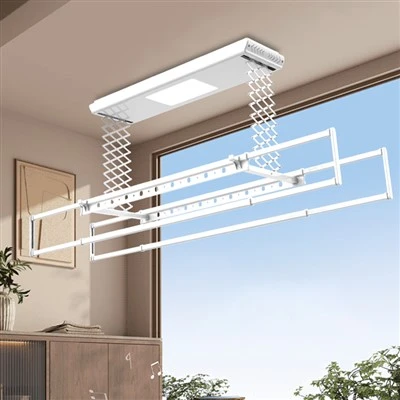
If you’re interested in checking out our hand-cranked drying racks (we have different sizes for small apartments, big families, and even commercial use), feel free to reach out to our team to chat about which model fits your needs. We can answer any questions you have about indoor vs outdoor use, weight capacity, or how the crank works—no pressure, just straight talk.
Folding Floor-Standing Clothes Airers References:
- U.S. Department of Energy, Energy Conservation Standards for Clothes Dryers, 2023.
- U.S. Energy Information Administration, Average Retail Price of Electricity, 2024.
- EPA, Sustainable Materials Management: Microplastic Pollution from Textiles, 2022.
- HomeAdvisor, Appliance Lifespan and Repair Cost Data, 2024.
- National Renewable Energy Laboratory, Heat Pump Dryer Energy Use Comparison, 2023.
Linyi Tianluo Intelligent Home Co., Ltd.
We are one of the most experienced hand-cranked clothes drying rack manufacturers in China, also support customized service. Welcome to buy high quality hand-cranked clothes drying rack for sale here from our factory. If you have any enquiry about cooperation, please feel free to email us.
Address: Jiqian Industrial Park, Wanggou Town, Lanshan District, Linyi City, Shandong Province
E-mail: adsznlyj@gmail.com
WebSite: https://www.ads-lyj.com/
