As a range hood fan supplier, I’ve spent thousands of hours talking to homeowners, contractors, and kitchen designers who all ask the same core question: How much noise is too much when choosing a range hood? For too long, noise has been an afterthought—something people only notice mid-cook when their exhaust fan is drowning out conversation, a podcast, or even a simple request to pass the salt. When I started in this industry 12 years ago, I assumed “power = noise” was an unbreakable rule. It took years of testing our own models and collaborating with audio engineers to prove otherwise: modern range hood fans aren’t one-size-fits-all, and their noise levels vary drastically based on size, type, and intended use. Today, I’m breaking down what those levels actually mean, so you can make a choice that works for both your kitchen’s performance and your peace. Range Hood Fan
First, let’s get one term straight: decibels (dB). This is the unit we use to measure sound intensity, and unlike linear measurements, a 10-dB increase doesn’t mean “10 times louder”—it means the sound is perceived as roughly twice as loud by the human ear. That’s why a 50-dB fan sounds almost unnoticeable in the background, while a 70-dB fan feels like standing next to a busy street. The Occupational Safety and Health Administration (OSHA) sets a 85-dB limit for 8 hours of exposure, which is way too high for a kitchen that’s used daily for 30 minutes at a time. For context, here’s a quick reference point: a whisper is about 30 dB, a normal conversation is 60 dB, a vacuum cleaner is 70 dB, and a lawnmower is 90 dB. That baseline matters when comparing different range hood fan types.
Let’s start with the most common type we supply: under-cabinet range hoods. These are the workhorses of small to mid-sized kitchens, installed directly under upper cabinets and usually connected to a duct that vents outside. Their fan sizes typically range from 300 CFM (cubic feet per minute, the measure of air they move) for compact models up to 600 CFM for larger ones. Here’s the noise breakdown for under-cabinet fans: the lowest-CFM models (300 CFM) usually clock in at 52–56 dB on low speed, and 62–65 dB on high. The mid-range, 400 CFM models (our best-seller for apartments and small homes) hover at 55–58 dB low and 63–67 dB high. The biggest mistake people make here is choosing a high-CFM under-cabinet for a large gas stove, which ends up cranking to 68–72 dB on high—equal to a loud conversation or a TV playing in the next room. I’ve had a customer in Chicago return a 600 CFM under-cabinet last year because it disrupted her toddler’s nap; we swapped it for a 450 CFM model with a quieter blower, and she still has great extraction without the noise. That’s a perfect example of how matching CFM to your needs, not just size, cuts down on noise.
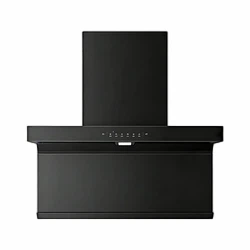
Next, wall-mounted range hoods, which are popular in larger kitchens where the stove sits against an exterior or interior wall. These usually have more space for larger blowers, so their CFM ranges from 600 to 1,200 CFM, and that extra space makes a huge difference in noise. Our 700 CFM wall-mounted fan, for instance, runs at 54–57 dB on low and 61–64 dB on high—almost 2 dB quieter than a same-CFM under-cabinet. The reason? Wall-mounted units often have side intakes that reduce turbulence, a big source of fan noise. The 1,000+ CFM commercial-grade wall hoods we supply for professional kitchens hit 65–68 dB on high, which is noticeable but still manageable for short bursts. I installed one in a restaurant in Detroit last year, and the line cooks said it doesn’t drown out their music during prep—exactly the balance a commercial space needs.
Then there’s insert range hoods, the hidden workhorses for custom kitchens. These are blowers that go inside a cabinet or wall, paired with a separate hood shell that you choose for style. They’re the most customizable, and their noise levels vary a lot depending on the blower size. Compact insert blowers (300–500 CFM) are quiet: 50–55 dB on low, 60–65 dB on high. The big commercial inserts (800–1,200 CFM) are slightly louder, at 58–62 dB low, 66–70 dB high. Because they’re hidden, they’re popular for high-end kitchens where the look matters more than the fan’s bulk, but their noise is a tradeoff for that clean design.
Wait, what about ductless range hoods? A lot of people go these for apartments where venting outside isn’t possible, but they’re often the loudest of the bunch. Ductless models rely on filters to recirculate air, and their smaller blowers plus the filter resistance means noise levels usually hit 58–62 dB on low, 68–72 dB on high. I’ve had a few customers come to us frustrated because their ductless hood was so loud they could barely cook dinner and talk at the same time; we usually suggest upgrading to a ductable model if their building allows it, since even a mid-tier ductable hood is 5–10 dB quieter. That 10-dB difference is huge—most people won’t notice a 5-dB gap, but 10 dB means a fan that feels like background noise vs. one that feels disruptive.
Now, let’s talk about what actually causes that noise, because it’s not just CFM. I used to think a higher CFM always meant more noise, but our engineering team proved that’s not true. The biggest factors are blower design, turbulence, and insulation. Turbulence happens when air moves too quickly through narrow spaces—so a fan that has wide, smooth ducts is quieter than one crammed into a tight cabinet. Blower size also matters: a 1000 CFM blower that’s 12 inches wide runs quieter than a 1000 CFM blower that’s only 8 inches wide, because the larger size moves the same amount of air at a slower, smoother speed. We use sound-dampening foam inside all our blowers, too, which cuts down on that high-pitched whine that makes some fans feel shrill instead of just loud.
There’s also a common misconception about silent range hoods. You’ll see ads for “ultra-silent 40 dB” fans, but that’s almost always a trick. Those numbers are often measured only on low speed, and if you check the high-speed noise, it jumps to 70+ dB. That’s a marketing tactic I hate—promising a quiet fan that only works when you’re barely using it. All our fans’ noise ratings are tested on all three speeds, with real cooking loads (like frying bacon, which creates a lot of smoke and requires high speed) so you know exactly what you’re getting.
So what does this mean for you, the person buying a range hood? First, match your CFM to your stove. A gas stove over 40,000 BTUs (most standard home stoves) needs 1 CFM per BTU, so that’s 400+ CFM. An electric stove or small gas stove can get by with 300–400 CFM. If your kitchen is open to a living area, go for the lower end of that CFM range to avoid noise when the fan is on high. If your kitchen is closed off, you can go higher. Second, check the noise rating at both low and high speed. If you’re using the fan for light cooking (warming up leftovers), low speed noise is what matters. For frying, searing, or boiling big pots, high speed is what you’ll use most. Third, ask about blower size and insulation—our team can tell you exactly which models have wider ducts or sound-dampening features if noise is a top concern.
At the end of the day, a range hood’s job isn’t just to look good—it’s to keep your kitchen free of smoke, grease, and odors without disrupting your daily routine. I’ve seen too many customers settle for a loud, cheap fan that ruins their cooking experience, or a quiet, underpowered fan that doesn’t do its job. That’s why we design our fans to balance performance and noise, because we know a good kitchen isn’t just about the stove or the countertop—it’s about the whole experience.

If you’re shopping for a new range hood fan and want to narrow down the right model for your needs, don’t second-guess the noise factor. Our team is here to walk you through the options, answer specific questions about decibel levels for different spaces, and help you find a fan that works for your kitchen and your budget. Reach out to connect for a no-obligation consultation, whether you’re a homeowner renovating, a contractor outfitting multiple properties, or a designer building a custom space.
High Speed Fan References
- Occupational Safety and Health Administration. (2023). Criteria for a Recommended Standard: Occupational Noise Exposure. U.S. Department of Labor.
- American Society of Heating, Refrigerating and Air-Conditioning Engineers. (2022). Ventilation for Acceptable Indoor Air Quality. ASHRAE Standard 62.2.
- Institute of Noise Control Engineering. (2021). Noise in Residential Kitchens: Perception and Impact. INCE International Journal on Noise Control Engineering.
- Range Hood Manufacturers Association. (2023). Standard Test Methods for Measuring Range Hood Fan Noise and Performance. RHMA Publication 101.
Shengzhou Geeking Electric Appliance Technology Co., Ltd.
We’re well-known as one of the leading range hood fan manufacturers and suppliers in China. With abundant experience, we warmly welcome you to buy bulk discount range hood fan in stock here and get free sample from our factory. Quality products and low price are available.
Address: No. 19, Putian Avenue, Pukou Subdistrict, Shengzhou City
E-mail: 13588516010@163.com
WebSite: https://www.geekingfan.com/
